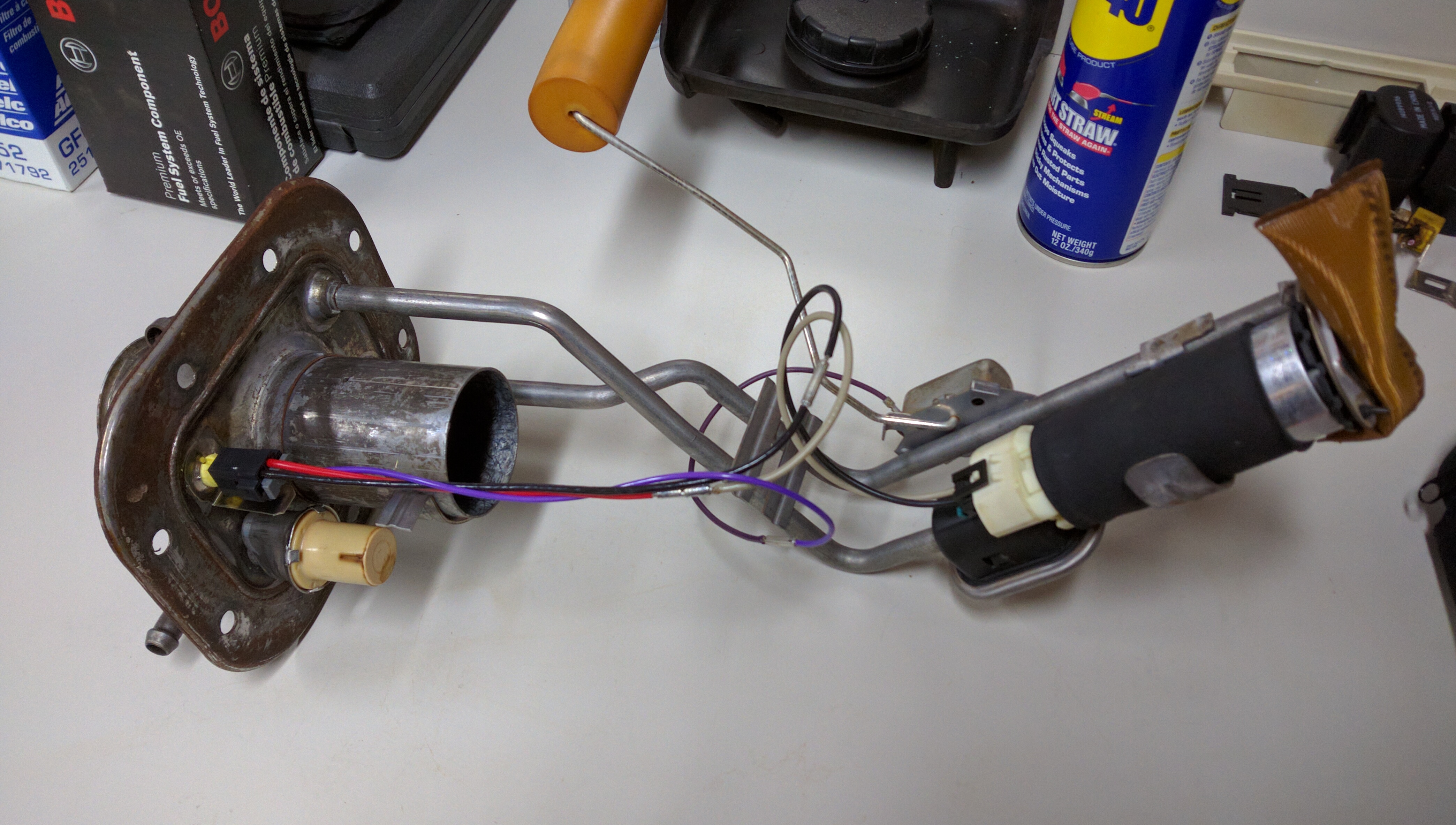
I used some metal barrels that I removed from some crimp connectors to solder the old and new wires together in a butt-splice configuration. Removing the plastic sleeves from the metal barrels is necessary because the plastic sleeves won't hold up well when exposed to gasoline.
I staggered the metal barrel splices to keep them from touching each other. The in-tank wiring is Teflon coated and very stiff. With the wires routed properly and the splices staggered they are unlikely to move around and so I'm not concerned with short-circuits.
Here's why: For gasoline vapor to ignite, the concentration in air must be between the lower explosive limit (LEL ~1.4% by volume) and the upper explosive limit (UEL ~7.6%). Inside a fuel tank the vapor concentration is usually far above the UEL - it’s *too rich* to burn. The bottom line: The fuel tank environment is too oxygen-poor and too vapor-rich for combustion. A spark in this environment can occur safely inside without igniting anything. Have you ever wondered how an electric fuel pump which has spark producing commutators and brushes doesn't explode your gas tank?
Direct link to this image:
https://corvette.westhaver.com/1988/fuel_pump/image_010.jpg